
Punk Rock and Urban Winemaking Culture
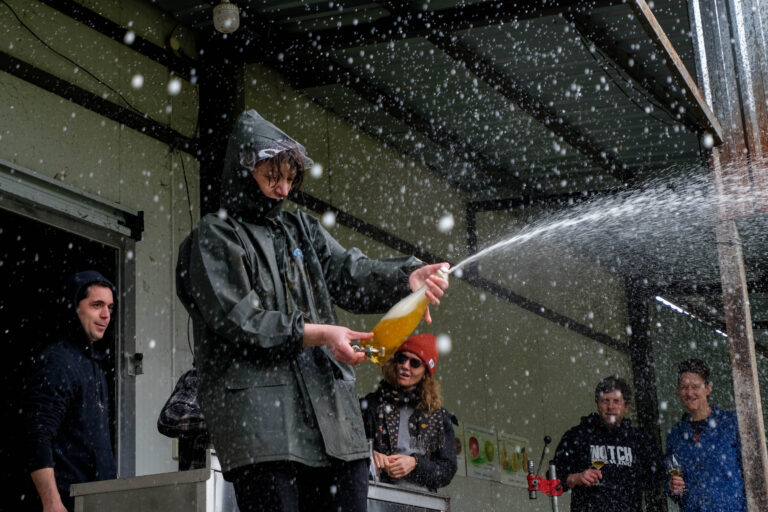
The most exciting story in Georgian wine is not the 8,000 years of wine making tradition. It’s how this tradition remains relevant and unfolds in the modern urban environment.
In the early 2000s, Georgia changed fast. Under President Mikheil Saakashvili, the country threw open its doors to global markets. Cities expanded. Families followed the opportunity. A generation of Georgians found themselves living in urban apartments while remaining deeply rooted in villages they visited on weekends. The land, the grandparents, the vines along the fence line are still very much theirs, however the young generation that was used to stealing wine from the family Qvevri in the marani now found themselves in the concrete jungle in a modern city. No wine was found in the apartment or the garage.
In Georgia, this is not a minor inconvenience. Wine belongs at every table, every celebration, every conversation that begins at sundown and runs until someone notices the sun coming back up. Its absence is a disruption of the natural order even among the young generation. So the fix was characteristically direct. Go to the village. Take some grapes. Bring them back to the city. Make wine.
What emerged was something remarkably similar to the punk rock movement. Nobody asked permission. Nobody waited for credentials. Nobody worried about established standards. They simply started making wine. There was no philosophy behind this. No manifesto. Grapes arrived stuffed into car boots. They went into garages, basements, bathtubs, old cooking pots; whatever got the job done. Whole clusters, stems, skins, seeds- everything in. The point was not refinement. The point was to have wine by Friday.
Out of that chaos, competition quietly emerged. Winemakers who had started making wine for friends began wanting to make better wine than their friends. Better wine built reputations. Reputations, eventually, built something that looked like a movement. Wine is art – label design was becoming an integral part of the formula as winemakers raced to grab attention and stand out.
The Artizani trio is perhaps its most complete expression of that time.
They were never trying to compete with Burgundy. They came from a culture where wine existed first as social necessity and only later as commercial ambition, and that sequence explains everything about how they make wine.
Their signature, Orange Affair (known simply as Smoky Orange), arrived partly by accident. The smokiness was a product of minimal intervention and low sulfur. Most producers would have corrected it – but for Artizani, it helped set them apart. It gave their wines a unique signature and made it possible for people to recognize it and so they leaned into it. The wine now has a cult following across Europe and the United States that no marketing campaign could have manufactured.
Forest of the Wild Berries, their Saperavi, works the same way. Ever got ink in your mouth from chewing on a pen? Dense, dark, ferocious, and unapologetic- built for intensity, not palatability. Saperavi’s greatness was never elegance. It was always power.
Today this urban winemaking culture is growing and evolving from Tbilisi to Kutaisi. We Are Gvino, led by Giorgi Kirkitadze, is what the next generation looks like, now with a little more infrastructure behind it. Access to equipment, facilities, and technical support, with creative freedom as the one true non-negotiable. It feels less like a winery and more like an artist collective that happens to produce wine. And while the new generation, standing on the shoulders of giants, is enjoying global recognition and improved collective spaces, the punk rock spirit of radical authenticity and do-it-yourself that Artizani and their generation defined is alive and stronger than ever.